Why The Poppy?
Have you ever seen people, usually women, in front of stores selling paper poppies? Have they encouraged you to wear one on your lapel? What is this all about?
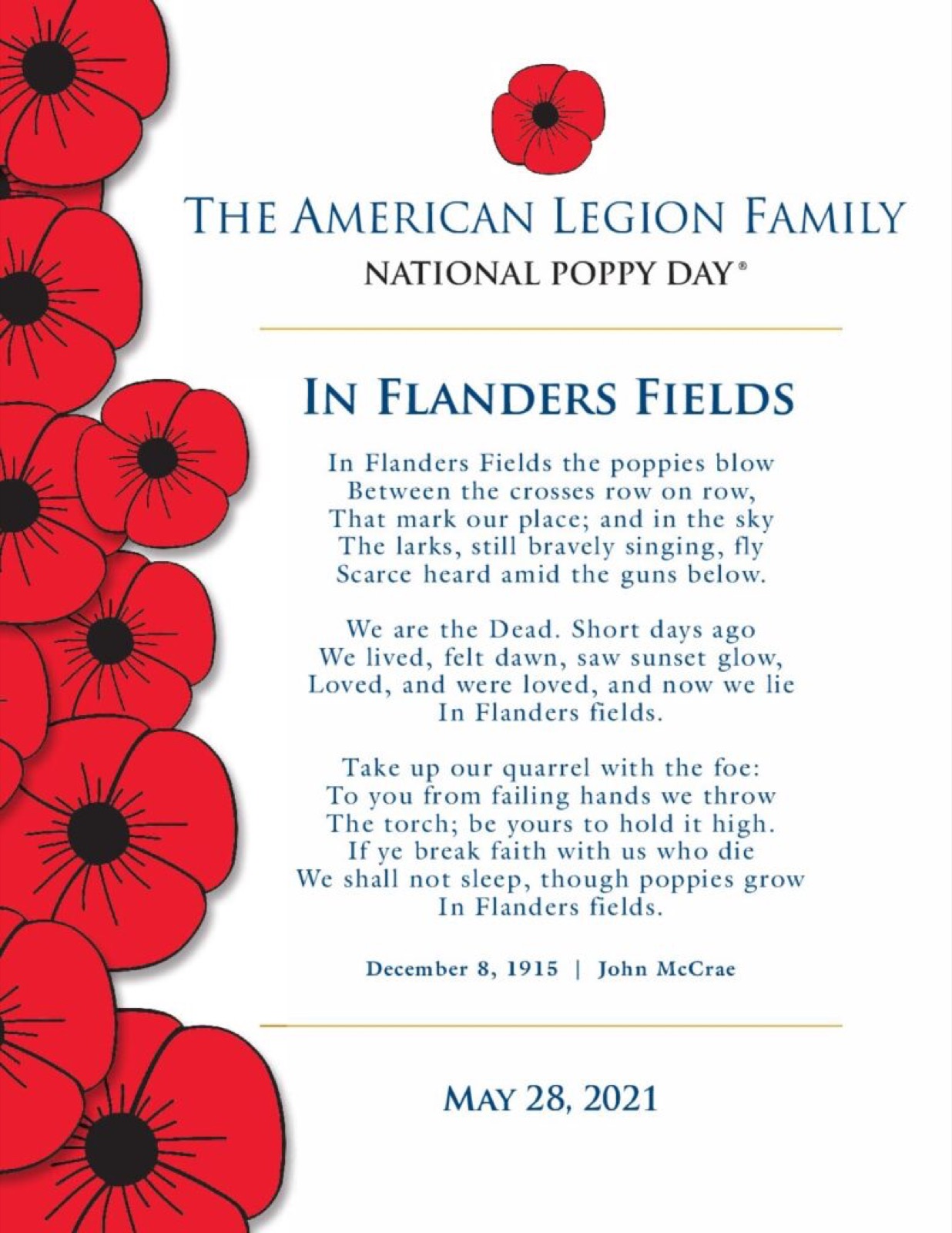
Scientists believe that soil in Belgium and France became enriched with lime due to the shelling in WWI. This is where the major battles took place, with trench warfare grinding on in one place for months over four years. The red poppy flourished in this new, churned-up soil. It was this poppy that inspired Canadian Lt. Col. John McCrae to write his famous poem “In Flanders Fields” in 1915. As a doctor he had been attending severely wounded soldiers. He was mourning the recent death of a close friend in a battle that had killed 87,000. Worn out, he rested in the back of a truck parked near some bomb craters. He noticed red poppies nodding here and there like blood sprinkled in the dirt. That scene was the impetus for his poem, written on the back of some scrap paper. In a weary voice he challenges us to take up the fight for freedom that so many had already given their lives for, asking future readers to protect freedom in their day.
The poem was published in many magazines in the United States and read at countless memorial services. A Georgia college professor, Mona Michael, read the poem. She was inspired by the significance of the red poppy: resilience, hope, honor and peace. She vowed to wear it all the time and made them from fabric to give to friends. Mona lobbied the Georgia chapter of the American Legion to adopt it as a symbol of remembrance, and succeeded. Encouraged, she lobbied the national American Legion. On September 27, 1920 the little red poppy became the official flower of the American Legion as the national emblem of remembrance. In 1924 distribution of the poppy became a national program of the American Legion. The American Legion commemorates the Friday before Memorial Day as Poppy Day, when Auxiliary members, the Women’s Section of the American Legion, offer poppies in shopping areas, seeking donations to help remember the fallen and to help veterans with their health needs. From the fields of Belgium and France in WWI to today in the United States, the poppy is the national symbol of hope, resilience, remembrance and honor worn on Memorial Day and on Veterans Day.
Poppies are a symbol of honor for the WWI fallen in many countries worldwide. Remembrance Day, first known as Poppy Day in the British Commonwealth and in many European countries, is commemorated on November 11th. The whole Commonwealth, led by the royal family, attends services wearing the poppy to remember the sacrifices of WWI. Poppy floral arrangements and wreaths are used as tributes.
Remembrance Day in 2014 was especially meaningful in London as the country mourned the beginning of WWI. As a commemorative art project created by artists Paul Cummins and Tom Piper, 888,246 ceramic poppies were made and gradually filled the moat at the Tower of London between July and November, installed by 21,688 volunteers. Each poppy represented a British military fatality during WWI. From November 5–11, 2018, the moat was filled with 10,000 torches to commemorate the end of the war. It took Beefeaters and volunteers less than an hour to light all of the torches each night.
If you see someone offering poppies, make a donation and put one in your lapel. Plant some red poppies in a planter. Give a package of red poppy seeds to a friend. By displaying the little red poppy you honor all those who have gone before us. On Veterans Day we honor the 53,402 Americans who died in combat and the 45,000 service men and women who died of the flu and pneumonia in service to their country during WWI.
This article draws on information from the Good Housekeeping article “Everything You Need to Know About the Symbolism Behind the Memorial Day Poppies,” the History Channel and the American Legion website.