2025 Memorial Day Observance features a History of Memorial Day
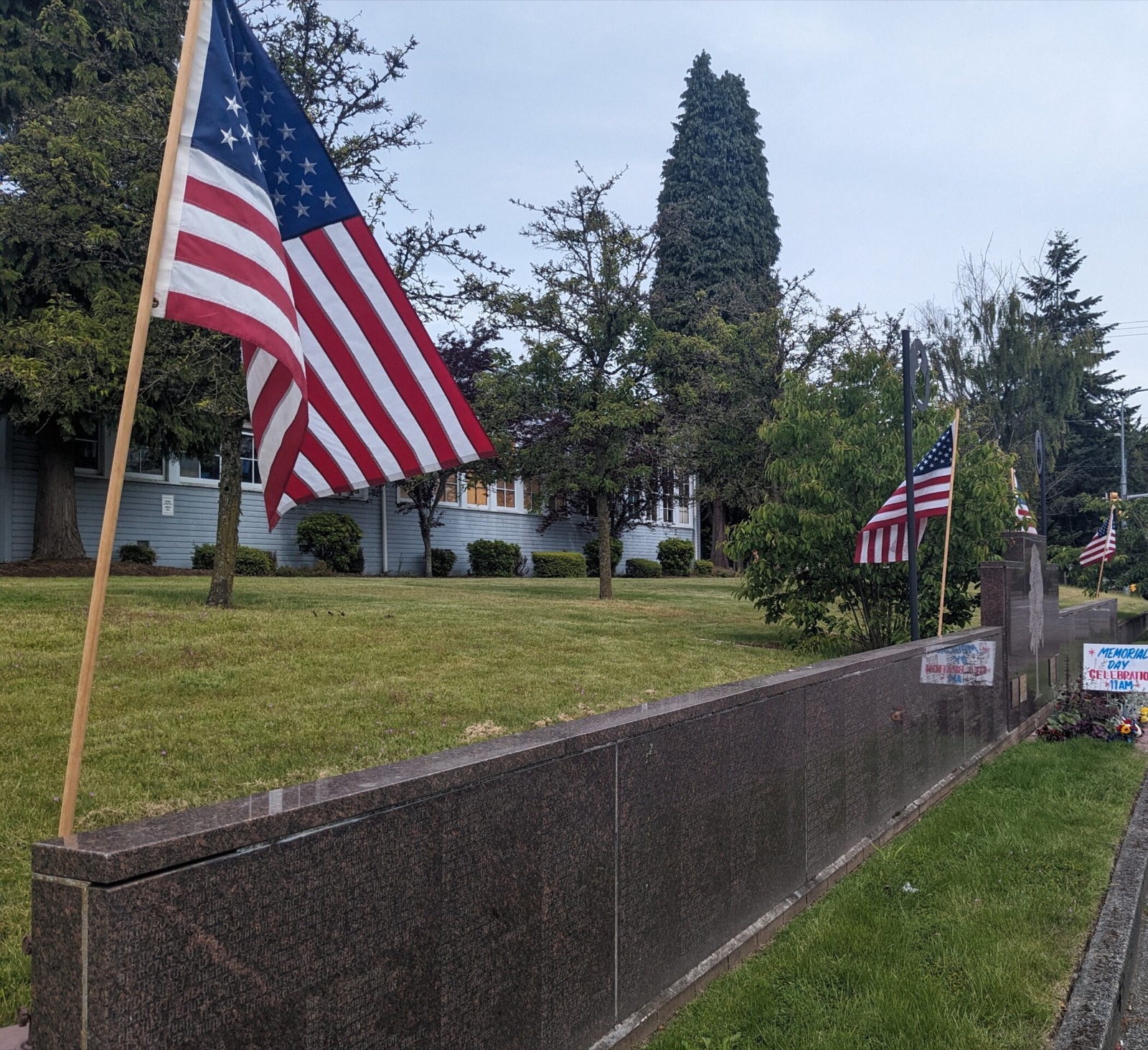
We held our annual Memorial Day observance on Monday, May 26th at 11 AM in the cafeteria of the old Sunnydale Elementary School, behind the Sunnydale Memorial, at the corner of 156th Street and Des Moines Memorial Drive. We had a good turn-out, and we thank all who attended.
Theodore Teppo was Master of Ceremonies, opening the observance with the American Legion Post 134 Color Guard (Peter Arends and Chris Plyman), followed by an invocation from Paul Ott of Transform. Kate Bysheim, former soprano soloist at Northwest Chorale, Seattle Pro Musica and University Unitarian Church, gave a spectacular rendition of the National Anthem. This year’s topic, delivered by Chris Plyman, American Legion Historian, was the history of Memorial Day. The program closed with Diane Kennish sharing the poem “In Flanders Fields,” followed by an open microphone where the audience shared moving personal memories.
Origins and early observances
The tradition began not as “Memorial Day” but as “Decoration Day,” emerging after the Civil War, when the graves of over half a million soldiers blanketed the American landscape. Communities decorated these graves with spring flowers in remembrance.
Two origin stories are historically recognized. The earliest documented post-Civil War observance took place in Charleston, South Carolina, where freed slaves and white missionaries organized a ceremony in 1865. Union soldiers who had died in a Confederate prison camp were given proper reburial, and on May 1, 1865 a crowd of 10,000 people staged a parade around the racetrack, with Black schoolchildren carrying flowers.
Waterloo, New York became the official birthplace of Memorial Day as an annual tradition. Beginning in 1866, under the leadership of local druggist Henry Welles and General John Murray, the village held formal cemetery ceremonies that continued yearly.
National expansion
General John Logan, leader of the Grand Army of the Republic, issued a nationwide proclamation in 1868 calling for “Decoration Day” to be observed annually on May 30. That year, memorial events took place in 183 cemeteries in 27 states, with the first national commemoration at Arlington National Cemetery, where General James Garfield addressed 5,000 participants who decorated the graves of 20,000 Civil War soldiers.
New York formalized the holiday in 1873, and by 1890 all Northern states had adopted it. Washington Territory established it as a legal holiday in 1888, and Washington State set May 30 as an official observance in 1891.
Evolution and modern traditions
By the twentieth century the observance had expanded to honor all Americans who died in military service. World War I inspired the poppy as a symbol; the American Legion adopted it in 1920, inspired by the poem “In Flanders Fields.”
“Memorial Day” gradually replaced “Decoration Day,” becoming the official federal name in 1967. Congress moved the observance to the last Monday in May in 1971. The National Moment of Remembrance Act, passed in 2000, encourages a moment of silence at 3 PM.
Celebrations following the formal remembrance have historical precedent: throughout the 19th century, solemn ceremonies were followed by picnics and foot races. While celebrations are fine, it is first and foremost a day of remembrance.